
The Hidden Cost of Manual Sales Reporting in Airports - And How Real-Time Sales Data Capture, Solves It
The Hidden Cost of Manual Sales Reporting in Airports – And How Real-Time Sales Data Capture, Solves It
Airports are evolving fast. They’re no longer just transport hubs — they’re bustling commercial ecosystems filled with retail stores, restaurants, and duty-free experiences that drive millions in non-aeronautical revenue every year.
But while passenger journeys have become smarter and digital-first, many airports still depend on manual processes to track retail and F&B sales and billing concessionaire.
At first glance, traditional reporting may seem manageable. After all, most concessionaires send spreadsheets or PDFs every week or month. But what airport leaders don’t see immediately is that this manual process hides enormous costs — in time, accuracy, and lost revenue potential.
The Real Problem: Manual Sales Reporting
Is Slowing Airports Down
Manual reporting is one of the most common operational bottlenecks in airport commerce.
When each concessionaire uses a different POS system and sends sales data manually, your commercial and finance teams spend countless hours just trying to make sense of the information.
The Hidden Costs You’re Paying:
1. Time Loss: Teams waste days — sometimes months — reconciling hundreds of reports, delaying billing cycles and decision-making.
2. Human Error: Manual data entry and inconsistent file formats lead to inaccuracies that affect billing, forecasting, and vendor relationships.
3. Lack of Accuracy: By the time reports reach airport management, the data is already outdated. Insights from last week or last month don’t help optimize today’s operations.
4. Revenue Leakage: Even small reporting discrepancies can cause underreported sales or incorrect concessionaire billing, directly impacting non-aero revenue.
In short, manual reporting doesn’t just cost time — it costs money, transparency, and growth.
The Core Issue: Fragmented POS Systems and Siloed Data
Most airports host dozens (sometimes hundreds) of concessionaires — each running on different POS systems, sales formats, and reporting frequencies.
Without a standardized method for sales capture, data becomes fragmented. This fragmentation makes it nearly impossible to:
- Validate sales data in real time
- Identify underperforming outlets quickly
- Automate concessionaire billing accurately
- Analyze KPIs like sales per passenger or average transaction value
As a result, airports rely on reactive management instead of proactive decision-making.
The Solution:
Real-Time Concessionaire Sales Data Capture
Real-Time Sales Data Capture eliminates these inefficiencies by automating how sales data is collected, validated, and analyzed.
Instead of waiting for manual uploads, the system connects directly to every concessionaire POS through secure APIs, flat files, or SFTP channels, capturing each transaction instantly and feeding it into a centralized analytics platform.
How It Works:
1. Data Collection: All concessionaires’ POS data is automatically pulled in real time.
2. Standardization: Different data formats are cleaned, validated, and unified.
3. Visualization: Airport executives view live dashboards showing sales performance, revenue by terminal, and category trends.
4. Automation: Billing, reconciliation, and forecasting are done automatically using real-time, verified data.
Why Real-Time Capture Changes the Game
1. Immediate Insights for Faster Decisions
No more waiting for end-of-month summaries. Executives can see sales performance instantly, compare stores, and react in the moment — whether it’s adjusting promotions, reallocating staff, or renegotiating leases.
2. Accuracy That Builds Trust
Validated, system-generated data ensures every transaction is accurate and traceable. This strengthens trust between the airport and concessionaires.
3. Automated Billing and Revenue Assurance
Contract-based billing rules are applied automatically. That means no missed percentages, no human miscalculations, and no disputes — only transparent, audit-ready records.
4. Operational Efficiency
Finance and commercial teams save hundreds of hours every month by eliminating manual consolidation and reporting tasks.
5. Smarter Revenue Optimization
By monitoring real-time KPIs like sales per passenger or sales per square meter, airports can identify which concessions drive profit and which need attention.
The ROI of Automation: What Airports Gain
When concessionaires know the billing process is transparent and data-backed, relationships strengthen, creating a more collaborative environment.
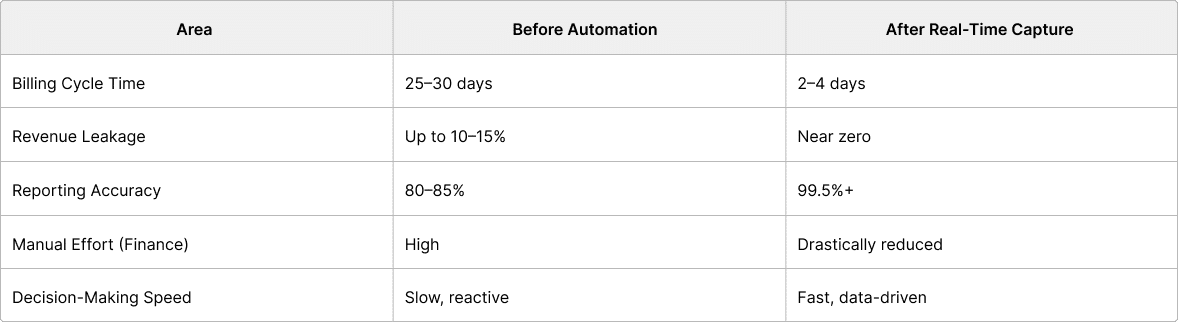
In practical terms, real-time capture doesn’t just make operations efficient — it can unlock 10–20% additional revenue potential by improving accuracy and timeliness.
Real Example: What Happens When Airports Automate
At a major international airport that adopted StoreSense for Airport, real-time sales data capture transformed operations within six months.
Outcomes included:
- 100% automated POS integration across all concessionaires
- 15% increase in reported revenue through better data accuracy
- 80% faster financial reconciliation
- Significant reduction in disputes and manual corrections
This change didn’t just save effort — it built confidence among stakeholders, improved tenant relationships, and directly boosted non-aero revenue.
The Future: From Real-Time to Predictive Retail
As AI and analytics evolve, real-time sales data will serve as the foundation for predictive airport retail strategies.
Airports will soon be able to:
- Predict spending trends by passenger segment or time of day
- Forecast demand by flight schedules
- Automate promotional campaigns based on real-time purchase behavior
This is the next step in airport retail transformation — where data not only informs but anticipates decisions.
Key Takeaways
- Manual reporting hides significant time and accuracy costs.
- Real-Time Sales Data Capture automates sales visibility, improves billing accuracy, and enhances decision-making.
- It’s a must-have for airports looking to scale non-aero revenue efficiently.
- Platforms like StoreSense for Airport bring automation, analytics, and transparency together in one solution.
Q&A
1. Why is manual sales reporting risky for airports?
Manual reporting increases the risk of human error, inconsistent data, and delayed insights. It often leads to incorrect billing and revenue leakage, making it difficult for airports to make timely and data-driven decisions.
2. How does Real-Time Sales Data Capture eliminate these issues?
It automates sales data collection directly from concessionaire POS systems. Every transaction is validated, standardized, and visible instantly—ensuring accurate reporting and faster revenue reconciliation.
3. What are the main benefits of automating concessionaire sales reporting?
Automation brings time savings, higher data accuracy, transparent billing, reduced disputes, and faster decision-making. Ultimately, it enhances operational efficiency and boosts non-aeronautical revenue.
4. Can airports integrate multiple POS systems under one solution?
Yes. Platforms like StoreSense for Airport are designed to integrate data from multiple POS systems through APIs, flat files, or secure SFTP connections—providing one unified, real-time view.
5. How much time can airports save by automating sales reporting?
Depending on the airport size, automation can reduce data consolidation and reconciliation time by up to 80%, while also shortening billing cycles from weeks to just a few days.