
From POS to Insights: The Power of Real Time Concessionaire Sales Data Capture in Airports
From POS to Insights: The Power of Real Time
Concessionaire Sales Data Capture in Airports
Airports are no longer just gateways for travel — they’ve become bustling commercial hubs filled with retail stores, restaurants, and entertainment zones. Every transaction that happens inside contributes to the airport’s non-aeronautical revenue, which now makes up a significant portion of overall income.
But there’s a problem: airport commercial teams are often dealing with fragmented data scattered across different systems, concessionaires, and terminals. Each vendor might use a different POS system, generating sales data in various formats that rarely talk to one another.
This lack of integration leads to slow reporting, poor visibility, and lost revenue opportunities.
The good news? Airports can change this reality through Real-Time Sales Data Capture — a modern approach that connects every point-of-sale across the airport and turns raw data into actionable insights.
Why Data Fragmentation Is a Growing Pain for Airports
Most airports work with dozens of retailers and F&B partners. Each partner brings their own POS setup, product mix, and pricing models. That complexity often translates into data chaos.
Here’s what typically happens:
- Data from multiple stores and restaurants is collected manually.
- Reports are shared days or even weeks later.
- Finance teams struggle to reconcile numbers for concessionaire billing.
- Decision-makers have no real-time view of what’s selling, where, and when.
As a result, opportunities to optimize retail operations or capture revenue leakages are missed. In today’s competitive environment, that’s no longer acceptable.
What Is Real-Time Sales Data Capture?
Real-Time Sales Data Capture is the process of collecting, validating, and integrating every transaction across airport retail and F&B outlets — as it happens.
Instead of waiting for end-of-day summaries or monthly reports, the system automatically consolidates POS data from every concessionaire into a single, reliable source.
This unified data stream is then pushed into airport business intelligence (BI) dashboards, giving airport leaders instant access to metrics like:
- Sales per passenger
- Sales per square meter
- Average transaction value
- Revenue by store, terminal, or brand
In short, it’s the backbone of data-driven airport operations.
Why Real-Time Matters More Than Ever
In a world where passenger movement and flight schedules change by the minute, airports can’t afford to wait for yesterday’s reports. Decisions need to happen in real time.
Here’s why this approach is becoming mission-critical for airport operators:
1. Instant Visibility Across the Terminal
With real-time data streaming in, commercial and operations teams can see what’s happening across all stores at any given moment.
If a food outlet suddenly experiences a sales dip during peak hours, action can be taken immediately instead of waiting for days for the data to appear.
2. Better Revenue Assurance
Automation reduces the risk of human error. By validating and consolidating every transaction instantly, revenue assurance improves, and concessionaire disputes decrease.
This also shortens settlement cycles and ensures faster, more accurate billing automation.
3. A Single Source of Truth
Airports no longer must juggle Excel sheets or manual uploads. Instead, all sales data — from duty-free fashion to coffee kiosks — flows into one centralized dashboard that anyone can trust.
4. Smarter Retail Decisions
Real-time insights reveal which stores are performing best, what products are trending, and how passengers are spending. These insights help airport managers make smarter leasing, pricing, and marketing decisions.
5. Enhanced Passenger Experience
When airports understand traveler preferences in real time, they can tailor promotions, adjust store layouts, or offer personalized deals — ultimately improving passenger satisfaction and spending.
How Real-Time Sales Data Capture Works
While the technology behind it sounds complex, the process can be broken into six clear steps:
1. Data Ingestion
Every concessionaire POS system — whether legacy or cloud-based — sends transaction data via secure APIs, flat files, or SFTP channels.
2. Validation & Standardization
The data is automatically cleaned, validated, and converted into a uniform format. This eliminates inconsistencies between vendors.
3. Real-Time Processing
Transactions are processed in near real time and made accessible through airport analytics dashboards.
4. Visualization & Analytics
Decision-makers can instantly view store-level performance, track KPIs like sales per passenger, and identify anomalies or revenue drops.
5. Automated Billing
Contract rules (fixed rent, percentage rent, thresholds) are applied automatically, generating accurate concessionaire invoices — without manual effort.
6. AI-Powered Alerts & Forecasting
Intelligent algorithms detect unusual trends, forecast demand spikes, and even suggest inventory or staffing adjustments — enabling truly proactive airport management.
The Business Benefits for Airport Leaders
Different teams inside the airport gain different advantages from real-time data capture:
For Commercial Heads
- Monitor performance by category, brand, or time of day.
- Identify low-performing stores early and renegotiate terms if needed.
- Optimize tenant mix based on passenger profiles and dwell time.
For Finance Teams
- Ensure transparency and accuracy in billing.
- Eliminate manual reconciliation processes.
- Accelerate settlement cycles and improve cash flow.
For IT & Operations
- Connect multiple POS systems into one standardized environment.
- Reduce integration complexity and manual interventions.
- Strengthen cybersecurity and data governance frameworks.
For Marketing Teams
- Launch targeted, time-sensitive promotions.
- Track campaign ROI in real time.
- Send digital receipts and personalized offers to travelers via airport apps.
Real Example: When Real-Time Data Pays Off
Take the example of an international airport (like Bangalore International Airport) that implemented a real-time sales data platform.
Within months, the airport achieved:
- 100% POS data automation across every concessionaire.
- 15% reduction in revenue leakage due to billing accuracy.
- Billing cycle time is cut from 30 days to under a week.
- Live performance dashboards accessible to commercial and finance teams 24/7.
The result? Greater transparency, faster decisions, and a measurable increase in non-aeronautical revenue — all powered by real-time insights.
Key Metrics to Measure Success
When evaluating a real-time data capture solution, focus on metrics that link directly to profitability and efficiency:
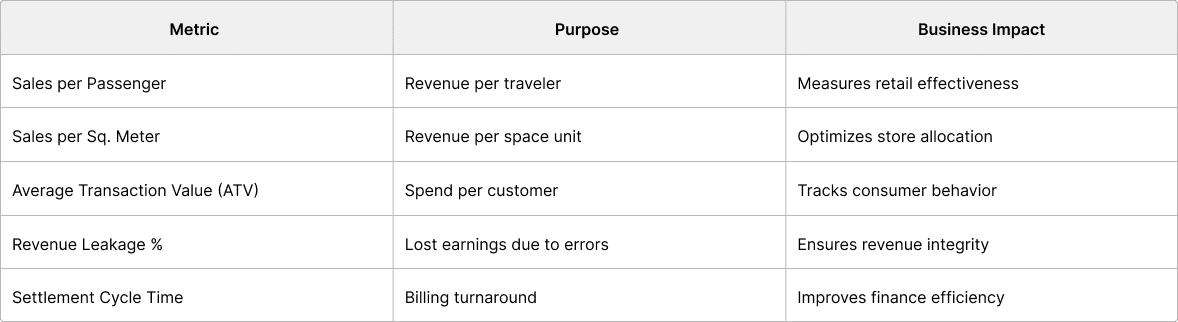
Monitoring these KPIs through a unified dashboard allows leadership to spot issues quickly and capitalize on opportunities faster.
Why This Matters to Airports in the USA, UK & Australia
Airports in advanced economies face unique challenges — from evolving passenger expectations to tighter margins and sustainability targets.
USA
Large airports manage hundreds of tenants. Without integrated data, tracking concession performance is nearly impossible. Real-time insights enable faster commercial decisions and improve vendor relationships.
UK
Post-Brexit duty-free changes have introduced complex pricing and compliance models. Real-time visibility ensures accuracy, regulatory alignment, and better concession control.
Australia
Regional airports are expanding their retail footprints rapidly. Scalable POS integration ensures they can manage multiple stores, food outlets, and service points efficiently as they grow.
Across these markets, real-time data capture helps airports turn complexity into clarity, ensuring every transaction counts.
Implementing Real-Time Sales Data Capture: Where to Begin
1. Audit your current POS landscape.
Identify how many systems are in use and where data silos exist.
2. Set up clear data governance policies.
Define who owns data, who accesses it, and how it’s validated.
3. Choose a unified integration platform.
Opt for solutions that support multi-POS integration, real-time validation, and automated billing (like StoreSense).
4. Start small, scale fast.
Begin with one terminal or a few key concessionaires to prove value before expanding the airport wide.
5. Train teams for adoption.
Success depends on cross-department collaboration — from IT to finance to commercial.
By taking these steps, airports can transition from reactive reporting to proactive management in just a few months.
The Future: Predictive and AI-Powered Analytics
The next phase of airport retail analytics will go beyond real-time — toward predictive insights. With AI, airports can anticipate which products will sell best before passengers arrive.
Imagine dashboards that:
- Predict retail performance by flight schedules.
- Identify potential stockouts or overstaffing in advance.
- Recommend promotional offers to maximize revenue.
This is the evolution of Real-Time Sales Data Capture — from monitoring transactions to predicting them.
Key Takeaways
- Fragmented sales data limits visibility, speed, and revenue growth.
- Real-Time Sales Data Capture unifies every transaction across all concessionaires.
- It improves billing accuracy, analytics, and operational agility.
- For airports in the USA, UK, and Australia, it’s a vital strategy for competitiveness.
- Platforms like StoreSense for Airport exemplify how data integration can transform airport retail performance.
Q&A
How can airports improve commercial performance through real-time sales data?
By connecting every POS system to a unified analytics platform that validates, visualizes, and analyzes sales as they happen — helping leaders make informed decisions and capture more revenue instantly.
What is Real-Time Sales Data Capture in airports?
Real-Time Sales Data Capture is the process of automatically collecting, validating, and standardizing transaction data from all retail and F&B outlets across an airport. It integrates data from multiple POS systems into a single dashboard, enabling instant visibility into sales performance, revenue trends, and passenger spending behavior.
Why is real-time POS data integration important for airports?
Airports work with numerous concessionaires using different POS systems. Real-time integration unifies this fragmented data, providing a single source of truth. It eliminates manual reporting delays, improves billing accuracy, supports revenue assurance, and allows airport teams to make faster, data-driven decisions.
How does real-time data capture improve concessionaire billing and revenue assurance?
Automated data capture ensures that every sale is logged accurately and immediately. Contract rules—like rent percentages or revenue thresholds—can be applied automatically, reducing errors and revenue leakage. Finance teams gain transparent, audit-ready billing and faster settlement cycles.
What key KPIs can airports track with real-time sales analytics?
Typical KPIs include:
- Sales per passenger
- Sales per square meter
- Average transaction value
- Category-wise revenue share
- Settlement cycle time Monitoring these metrics in real time helps airport commercial teams identify performance gaps and optimize non-aeronautical revenue.
Can Real-Time Sales Data Capture work with different POS systems across concessionaires?
Yes. A robust platform like StoreSense for Airport connects to multiple POS systems through APIs, flat files, or secure FTP. It standardizes diverse data formats into a consistent structure, ensuring smooth integration without disrupting existing vendor operations.